In 1816 Captain Charles H. Marshall founded the Black Ball Line, the first scheduled transatlantic passenger service, employing a fleet of clipper ships, one of which was commanded by the founder’s brother Captain Alexander Marshall. This service operated for over 60 years between New York and Liverpool flying the house flag, which consisted of a black ball centered on a red background.
One hundred and twelve years later, Captain Alexander Marshall’s great grandson Captain Alexander Marshall Peabody chose the same flag for his fleet, the Puget Sound Navigation Company, which operated ferries on Puget Sound under the trade name Black Ball Line. Black Ball Line was at one time the nation’s largest privately owned ferry system.
On December 30, 1950, after years of failed negotiations with the State of Washington for fare increases, Black Ball Line sold 16 ferries, 20 terminals, one destroyer escort and other miscellaneous items to the state’s Toll Bridge Authority.
Captain Peabody retained five vessels, one destroyer escort, the rights to the Seattle-Victoria route and terminals in Seattle, Port Angeles and Victoria. In 1951, using these assets he organized Black Ball Ferries, Ltd. a Canadian company, which operated until the sale of most of its assets to the British Columbia government in 1961.
Black Ball Transport, Inc. can also trace its origins to the Black Ball Line, though in somewhat less direct fashion. Our founder, R.J. Acheson, began his career in transportation at the age of 11 in Medicine Hat, Alberta with the Canadian Pacific Railway as a callboy, eventually becoming a dispatcher. In 1924, he decided to move to Seattle. He first worked as a freight checker for the Nelson Steamship Company and later became general manger. In 1932 he became traffic manager for Black Ball Line. In 1936 he purchased Black Ball Freight Service, which had been a subsidiary of Black Ball Line. By 1951, Mr. Acheson’s operation included 200 trucks and trailers and employed 125 people.
In 1952, Mr. Acheson and his wife Lois organized a new subsidiary of Black Ball Freight Service, naming it Black Ball Transport, Inc. Mr. Acheson requested from Captain Peabody permission to incorporate a new version of the famous Black Ball flag for his new company. The new flag was very much like the old, with the addition of a thin white circle around the black ball.
In the first few years of its existence, Black Ball Transport, Inc. operated the IROQUOIS, a steamship Mr. Acheson purchased from Black Ball Line and converted to a motor freighter. The IROQUOIS ran the overnight freight run year-round between Seattle, Port Townsend and Port Angeles. From 1959 to 1969, she ran in the summer only. In 1973 the IROQUOIS was sold to Alaska-Shell of Akutan, Alaska and converted into a king crab processing vessel, operating in that capacity until the king crab business dwindled in the 1980s. She was finally towed out to sea and sunk on April 15, 1984.
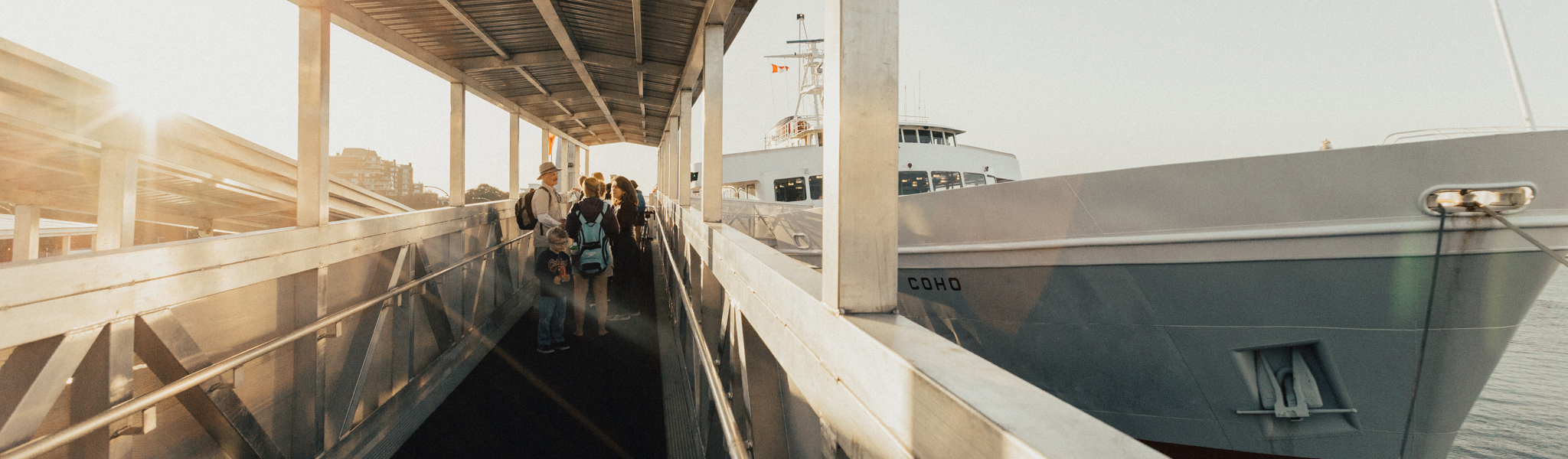
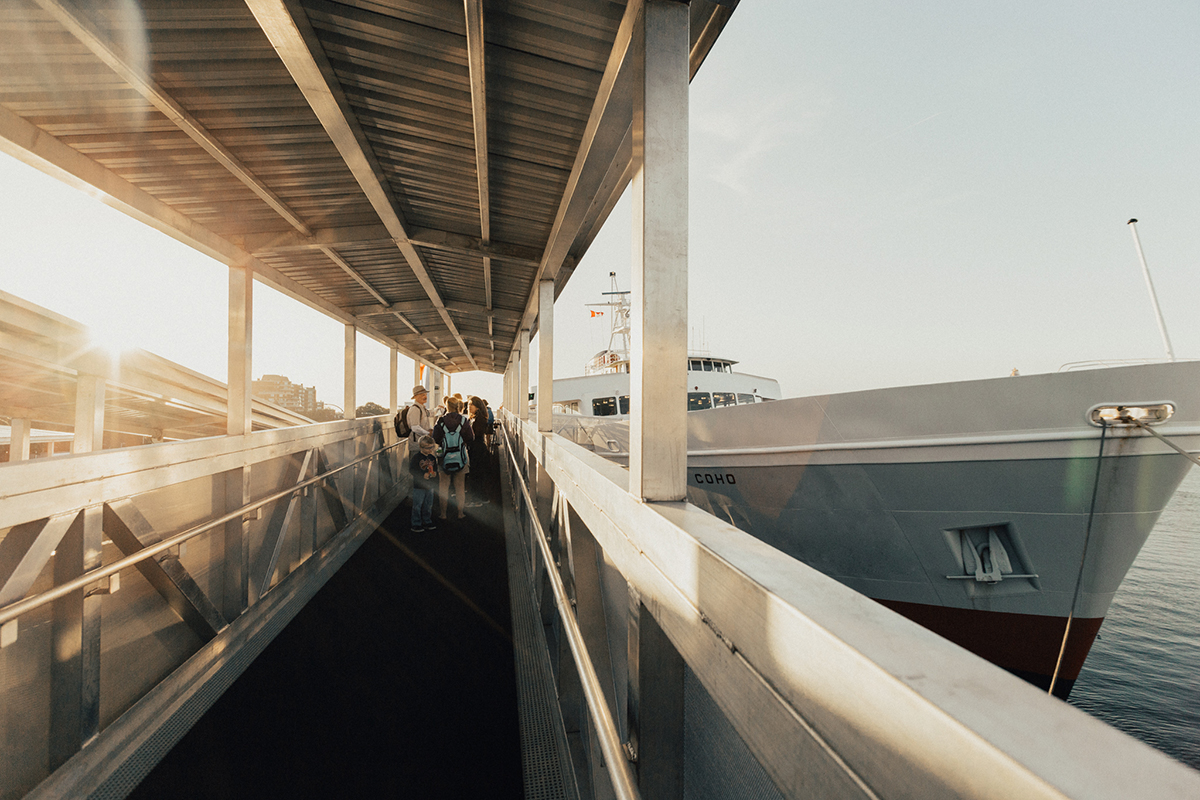
In 1959, Black Ball Transport, Inc. built an auto and passenger ferry, naming it the M.V. Coho, after the magnificent silver salmon found in Puget Sound and adjacent waters. Philip F. Spaulding & Associates of Seattle designed the vessel, and her keel was laid January 12, 1959 at the Puget Sound Bridge & Dry dock in Seattle. She made her first commercial sailing to Victoria, B.C. on December 29, 1959.
Initially, the M.V. Coho not only serviced the Port Angeles to Victoria vehicle and passenger route, but also carried freight trucks between Seattle, Port Angeles, Port Townsend and Victoria for Black Ball Freight Service. In 1973, Black Ball Freight Service was sold to ROCOR International, but Black Ball Transport, Inc. has continued to operate the M.V. Coho on the Port Angeles to Victoria vehicle and passenger route to this day.
The M.V. Coho is 341.6 feet long, has a breadth of 72 feet, a draft of 12.6 feet, twin 8-foot stainless propellers and twin rudders. She was originally powered by two Cooper-Bessemer's diesel engines rated at 2,080 BHP each. The Cooper-Bessemer's were replaced in 2004 with two General Motors Electro-Motive Division Main Propulsion Engines rated at 2,550 BHP each.
In addition to the engine refit, the M.V. Coho has undergone many improvements over the years, including additional seating, enlargement of the Coffee Shop, installation of a solarium, and a sewage treatment plant.
The M.V. Coho has a vehicle clearance of 14 feet, and a carrying capacity of 110 vehicles and 1,000 passengers. She undergoes routine maintenance in dry-dock every year, is completely U.S. Coast Guard-approved and carries state-of-the-art lifeboat and evacuation systems meeting or exceeding all International SOLAS (Safety of Life at Sea) requirements.
|